
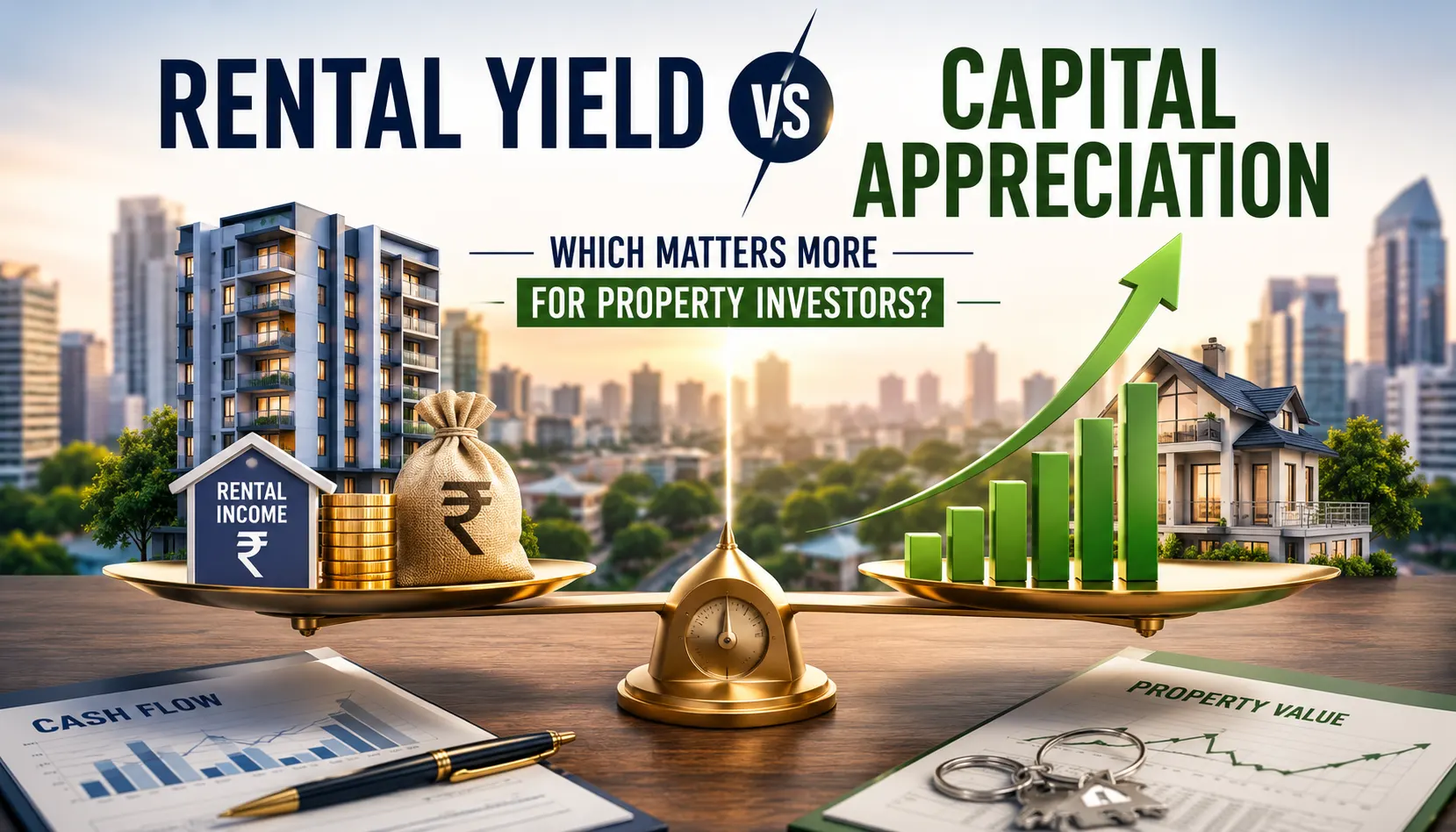
Rental yield vs capital appreciation — which actually drives returns for Gurgaon property investors in 2026? A data-backed comparison with formulas and worked examples.
Rental Yield vs Capital Appreciation: Which Matters More for Property Investors?
For most Gurgaon investors, capital appreciation does the heavy lifting on total returns, while rental yield provides cash flow stability. Gurgaon rental yields currently average just 2–4%, but appreciation in active sectors has run 8–30% depending on location and timeframe. The right balance depends on whether you need a monthly income now or are optimizing for long-term wealth creation. Most serious investors track both — but weight their decisions differently depending on their goals.
If you haven’t already, read our Complete Guide to Calculating ROI on Property Investment first — this article assumes you understand the basic ROI formula and builds on it.
Two Very Different Return Streams
Every property investment generates returns through exactly two channels:
- Rental yield — the income the property produces while you hold it.
- Capital appreciation — the increase in the property’s resale value over time.
They behave completely differently, are taxed differently, and reward different kinds of investors. Treating them as interchangeable is one of the most common reasons people misjudge a Gurgaon investment.
Rental Yield: The Cash Flow Engine
Formula:
Gross Rental Yield (%) = (Annual Rent ÷ Property Price) × 100
Net Rental Yield (%) = [(Annual Rent − Annual Expenses) ÷ Total Cost of Ownership] × 100
What Gurgaon Yields Actually Looks Like
Rental yields across Gurgaon currently average around 2–4%, with most established residential sectors clustering near 2%. Specific micro-markets confirm this pattern — New Gurgaon and Sector 65 both report average rental yields of roughly 2%, while more affordable, emerging corridors like Sohna tend to land slightly higher, in the 3–4% range, partly because purchase prices are lower relative to achievable rents.
Why Yield Matters
- Predictable monthly cash flow — useful if you need income now (retirees, EMI offsetting).
- Lower volatility — rent doesn’t swing the way resale prices do.
- Easier to forecast — you can estimate rental yield with reasonable accuracy before buying, using comparable listings nearby.
Why Yield Alone Disappoints in Gurgaon
A 2–4% yield is lower than what you’d earn from a fixed deposit or debt mutual fund over many years. If you’re buying a Gurgaon property purely for rental income, you need to go in with realistic expectations — yield-only investors are usually better served by REITs or other income-focused instruments, not direct ownership of premium Gurgaon real estate.
Capital Appreciation: The Wealth-Creation Engine
Formula:
Capital Appreciation (%) = [(Current Value − Purchase Price) ÷ Purchase Price] × 100
Annualized Appreciation (%) = [(Current Value ÷ Purchase Price)^(1/Years) − 1] × 100
What Gurgaon Appreciation Actually Looks Like
This is where Gurgaon’s numbers get more interesting. New Gurgaon flat rates have appreciated 65.9% over 3 years and 133% over 5 years. Sector 65 has appreciated 33.8% over 3 years and 104.1% over 5 years. More broadly, premium and developing areas across Gurgaon have seen price growth of 15–30% in recent periods, and analysts expect continued annual appreciation of 10–20% in prime areas and up to 30% in emerging sectors going forward, driven largely by infrastructure expansion.
Delhi-NCR’s broader momentum supports this: the region recorded 30% YoY sales growth in Q1 2026, with Gurugram alone contributing nearly 73% of regional launches — a strong demand signal that typically precedes sustained price growth in supply-constrained corridors.
Why Appreciation Matters
- It’s where most of the real return lives in Gurgaon specifically — often 3-4x the contribution of rental yield.
- Compounds over the holding period — a 10% annual appreciation roughly doubles property value every 7 years.
- Tax-deferred until sale — unlike rental income, which is taxed annually, appreciation gains aren’t realized (or taxed) until you sell.
Why Appreciation Alone Is Risky
- It’s not guaranteed — past appreciation reflects historical demand and infrastructure timing, not a forward promise.
- It’s illiquid — you can’t access appreciation gains without selling or refinancing.
- It’s concentrated risk — a property-only portfolio betting purely on appreciation lacks the diversification a balanced investor typically wants.
- Recent quarterly data show some premium corridors, like Golf Course Road, can also see short-term depreciation (around 8% in one recent quarter) even within a longer-term uptrend — appreciation is not a straight line.
Side-by-Side: Gurgaon Micro-Markets
| Micro-market | Rental Yield | 3-Yr Appreciation | Best Suited For |
|---|---|---|---|
| Golf Course Road | 2–3% | Premium, slower % growth, high base | Long-term wealth preservation |
| Sector 65 | ~2% | 33.8% | Balanced growth investors |
| New Gurgaon | ~2% | 65.9% | Appreciation-focused, longer horizon |
| Dwarka Expressway | 2–3% | Mixed, some recent appreciation | Infrastructure-driven bets |
| Sohna | 3–4% | High-growth, emerging | Yield + early-stage appreciation |
So Which One Should You Prioritize?
It depends on what problem you’re actually solving.
Choose to weight rental yield more if:
- You need the property to partially or fully cover its own EMI.
- You’re investing for passive income in retirement.
- You have a shorter time horizon (3–5 years) and can’t rely on appreciation playing out.
- You value liquidity and predictability over upside.
Choose to weight capital appreciation more if:
- You have a 7–10-year (or longer) holding horizon.
- You’re investing in an emerging corridor with confirmed infrastructure pipelines (metro extensions, expressways).
- You don’t need the rental income to service the investment.
- You’re comfortable with the illiquidity and lack of a guaranteed outcome.
The realistic answer for most investors
Most successful Gurgaon investors don’t choose one — they sequence them. Early in the holding period (years 1–5), a modest rental yield offsets carrying costs. Later (years 5–10+), appreciation becomes the dominant return driver as the surrounding infrastructure matures and the sector re-rates.
This is exactly why the Total ROI formula in our complete guide combines both — calculating either in isolation gives you an incomplete, often misleading picture of your actual return.
A Quick Gut-Check Example
Two investors, same ₹1 crore budget, different sectors:
Investor A — Golf Course Road
- Lower yield (~2%), high base price
- Slower % appreciation, but on a larger base
- Total ROI: moderate, stable
Investor B — New Gurgaon
- Similar yield (~2%)
- Much higher % appreciation (65.9% over 3 years)
- Total ROI: higher, but on a less-established corridor with more execution risk
Neither is “wrong” — they’re optimized for different outcomes. The mistake is buying into either without knowing which lever you’re actually pulling.
FAQs
Is capital appreciation more important than rental yield in Gurgaon?
For most established and emerging Gurgaon sectors, yes — appreciation has historically contributed a larger share of total returns than rental yield, which averages only 2–4% citywide. However, appreciation is not guaranteed, while rental income is comparatively more predictable.
Can a property have good yield and good appreciation?
It’s rare but not impossible — typically found in early-stage, infrastructure-backed corridors where prices haven’t yet caught up to demand (some parts of Dwarka Expressway and New Gurgaon have shown this pattern in recent years). These windows tend to close as the area matures.
Should I avoid low-yield properties entirely?
No — low yield doesn’t mean low return; it means the return is coming from a different channel (appreciation). Evaluate total ROI, not yield in isolation.
Next Article
Disclaimer: This article is for educational purposes and reflects market data as of mid-2026. Real estate yields and appreciation rates fluctuate; consult a licensed financial advisor or real estate professional before making investment decisions.