
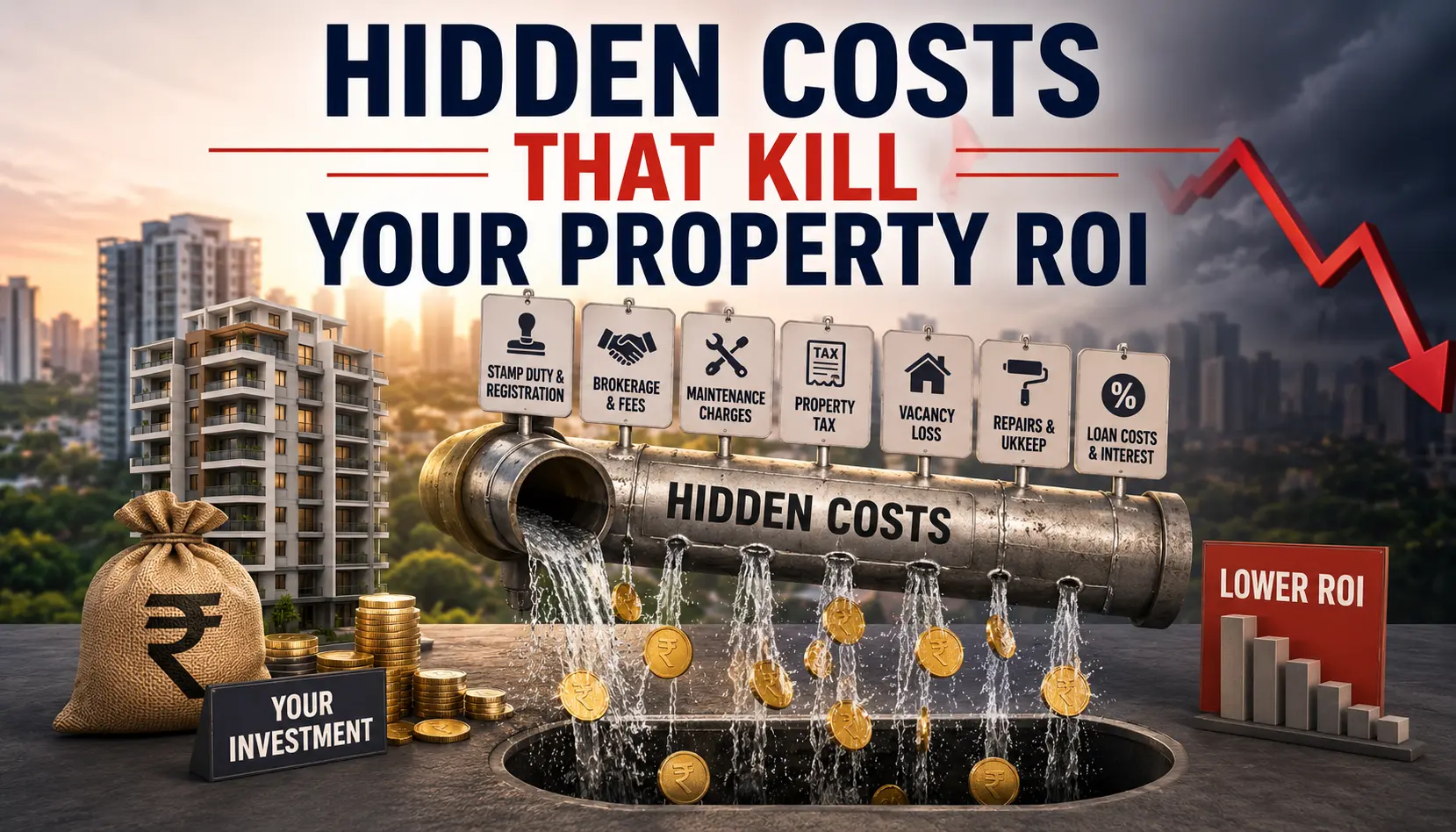
Stamp duty, taxes, maintenance, vacancy, and more — Hidden Costs That Kill Your Property ROI, with formulas and worked examples for any property market.
The biggest hidden costs eroding property ROI are transaction taxes (stamp duty/registration, typically 5–8% of purchase price), GST or VAT on new/under-construction units where applicable, brokerage (1–2%), legal and documentation fees, maintenance and society charges, vacancy periods, and exit costs at resale (capital gains tax, brokerage again). Together, these can reduce your real ROI by 10–20% compared to the number most buyers calculate using just the purchase price and rent.
If you haven’t already, read our Complete Guide to Calculating Property Investment ROI first — this article assumes you understand the core ROI formula and builds on it.
Why “Hidden” Costs Aren’t Actually Hidden — They’re Just Ignored
None of the costs in this article are secret. Tax rates are published. Maintenance charges are usually disclosed before you buy. The problem isn’t visibility — it’s that most ROI calculations simply leave them out, because they’re inconvenient to include.
The result: an investor calculates ROI using only the purchase price and rental income, gets a number that looks attractive, and is genuinely surprised a few years later when actual returns fall short. The gap isn’t bad luck. It’s an incomplete formula.
Cost #1: Transaction Taxes (Stamp Duty / Registration / Transfer Tax)
This is the largest hidden cost most buyers underestimate, and it hits you on day one — before you’ve earned a single unit of return.
Depending on your jurisdiction, property transfer taxes (stamp duty, registration charges, or transfer duty) typically add 5–8% of the purchase price, though exact rates vary significantly by location, property type, and buyer category.
On a property worth 100 units of currency:
Transaction tax (assume 6%) = 6 unitsIf your ROI calculation uses the base purchase price as the denominator instead of price + transaction tax, you’re overstating your return right from the start — before the property has done anything for you.
Always check your local stamp duty/registration schedule before modeling ROI; rates differ widely by city, state, and country.
Cost #2: GST / VAT on New or Under-Construction Property
If you’re buying new-build or under-construction property (as opposed to resale/ready-to-move), consumption taxes like GST or VAT often apply — and ready-to-move buyers typically don’t face this cost at all.
Where applicable, this tax is commonly in the 5–12% range on the base price, frequently with no input tax credit available to the individual buyer, meaning it can’t be offset elsewhere.
This is one of the clearest reasons mixing up new-build and resale cost structures in your ROI math leads to wrong conclusions — they are not the same financial product, even within the same building.
Cost #3: Brokerage / Agent Commission
Brokerage in most property markets typically runs 1–3% of transaction value, paid by the buyer, the seller, or split between both, depending on local convention and the specific deal.
This is easy to forget because it’s often negotiated outside the main transaction paperwork — which is exactly why it doesn’t make it into most buyers’ ROI spreadsheets.
Cost #4: Legal and Documentation Fees
Title verification, sale deed drafting, and conveyancing typically cost a few hundred to a few thousand units of currency, depending on the complexity of the transaction and local legal requirements.
Skipping proper legal due diligence to save this cost is one of the most common false economies in real estate — title disputes and unclear records are a real risk in many markets, particularly for newer developments or peripheral areas.
Cost #5: Interiors, Furnishing, and Move-In Costs
Even a property marketed as “move-in ready” usually isn’t fully ready. Fittings, basic furnishing, painting, and minor repairs routinely add a meaningful lump sum to your real cost of ownership.
This is a genuine cost of ownership, not optional — yet it’s rarely included when buyers calculate ROI off the base purchase price alone.
Cost #6: Maintenance and Recurring Charges
Ongoing, and easy to understand because it’s a small monthly number that compounds over the years.
Most managed residential properties (apartments, gated communities, condos) carry monthly maintenance, society, or HOA-style charges. Even a modest monthly fee adds up to a substantial sum over a 5–10-year hold — often exceeding the combined one-time brokerage and legal costs, spread invisibly across years.
Cost #7: Vacancy Periods
If you’re renting the property out, vacancy is the cost everyone forgets until it happens to them.
A property vacant for just 2 months a year overstates your assumed rental yield by roughly 15%, because most buyers calculate yield assuming 12 months of occupied rent.
Formula:
Yield Overstatement (%) ≈ (Vacant Months ÷ 12) × 100Build a realistic vacancy buffer (1–2 months/year) into every yield calculation, not just the optimistic 12-month figure — especially in markets with seasonal demand or longer tenant turnover cycles.
Cost #8: Property Tax / Council Tax
Often small individually, but recurring and easy to forget in year-one excitement. Annual property tax varies by location, property value, and local government rates, and while usually modest, it still belongs in your net rental income calculation — not as an afterthought.
Cost #9: Financing Costs (If Leveraged)
If you’re using a mortgage or loan to fund the purchase, loan processing fees, prepayment penalties, and the interest cost itself materially affect real ROI — particularly in higher interest rate environments. A leveraged ROI calculation is fundamentally different from a cash-purchase ROI calculation, and conflating the two is a common modeling error.
Cost #10: Exit Costs at Resale
The cost that hits hardest because it arrives at the very end, when investors have stopped paying attention to expenses and are only thinking about the appreciation gain.
- Capital gains tax — applicable on the profit from sale, with rates and any indexation or exemption benefits depending on your holding period and local tax rules at the time of sale.
- Brokerage on the sale side — typically another 1–3%.
- Pending dues clearance — society/HOA dues, pending maintenance, or loan foreclosure charges if applicable.
A property that appreciated significantly on paper can deliver a meaningfully lower realized return once exit costs are netted out — which is exactly why total ROI should be evaluated as a “round-trip” number, not just an entry-to-peak-value calculation.
The Full Picture: Stated ROI vs. Real ROI
| Cost Component | Typical Impact |
|---|---|
| Transaction tax (stamp duty/registration) | +5–8% to cost base |
| GST/VAT (new-build only, where applicable) | +5–12% to cost base |
| Brokerage (buy side) | +1–3% to cost base |
| Legal/documentation | Small flat fee |
| Interiors/furnishing | Meaningful flat sum |
| Maintenance (annualized over hold) | Compounds over the years |
| Vacancy (if rented) | ~15% yield overstatement if ignored |
| Financing costs (if leveraged) | Varies with the rate environment |
| Exit costs (resale) | Capital gains tax + 1–3% brokerage |
Add these up across a typical hold, and it’s common to see stated ROI overstate real ROI by 10–20%, sometimes more in high-tax or high-transaction-cost jurisdictions. This is precisely why any serious ROI calculation should use Total Cost of Ownership — not purchase price — as the base.
How to Protect Your ROI From These Costs
- Always calculate Total Cost of Ownership before you calculate ROI — never use purchase price as your denominator.
- Build in a realistic vacancy buffer (1–2 months/year) for rental yield projections.
- Separate new-build and resale cost structures — don’t compare them on the same spreadsheet without adjusting for applicable taxes.
- Model leveraged and unleveraged ROI separately if you’re using financing — they answer different questions.
- Budget for exit costs upfront, even if the sale is years away — it changes how you think about your real target return.
- Don’t skip legal due diligence to save a small fee — the downside risk is disproportionate to the cost.
FAQs
What’s the single biggest hidden cost in a property purchase?
Transaction taxes — stamp duty, registration, or transfer duty — are usually the highest single hidden cost in most markets, typically 5–8% of the purchase price, and they’re paid upfront before any return has been generated.
Does GST or VAT apply to all property purchases?
No. In most jurisdictions that levy it, GST/VAT applies only to new-build or under-construction property, not to resale or already completed units. Always confirm the rule in your specific market.
How much should I budget for hidden costs beyond the purchase price?
As a general rule of thumb, budget an additional 10–18% on top of the quoted purchase price to cover transaction taxes, brokerage, legal fees, and basic move-in costs — before factoring in ongoing costs like maintenance and financing.
Next Article
-
-
Rental Yield vs Capital Appreciation: Which Matters More for Property Investors?
-