
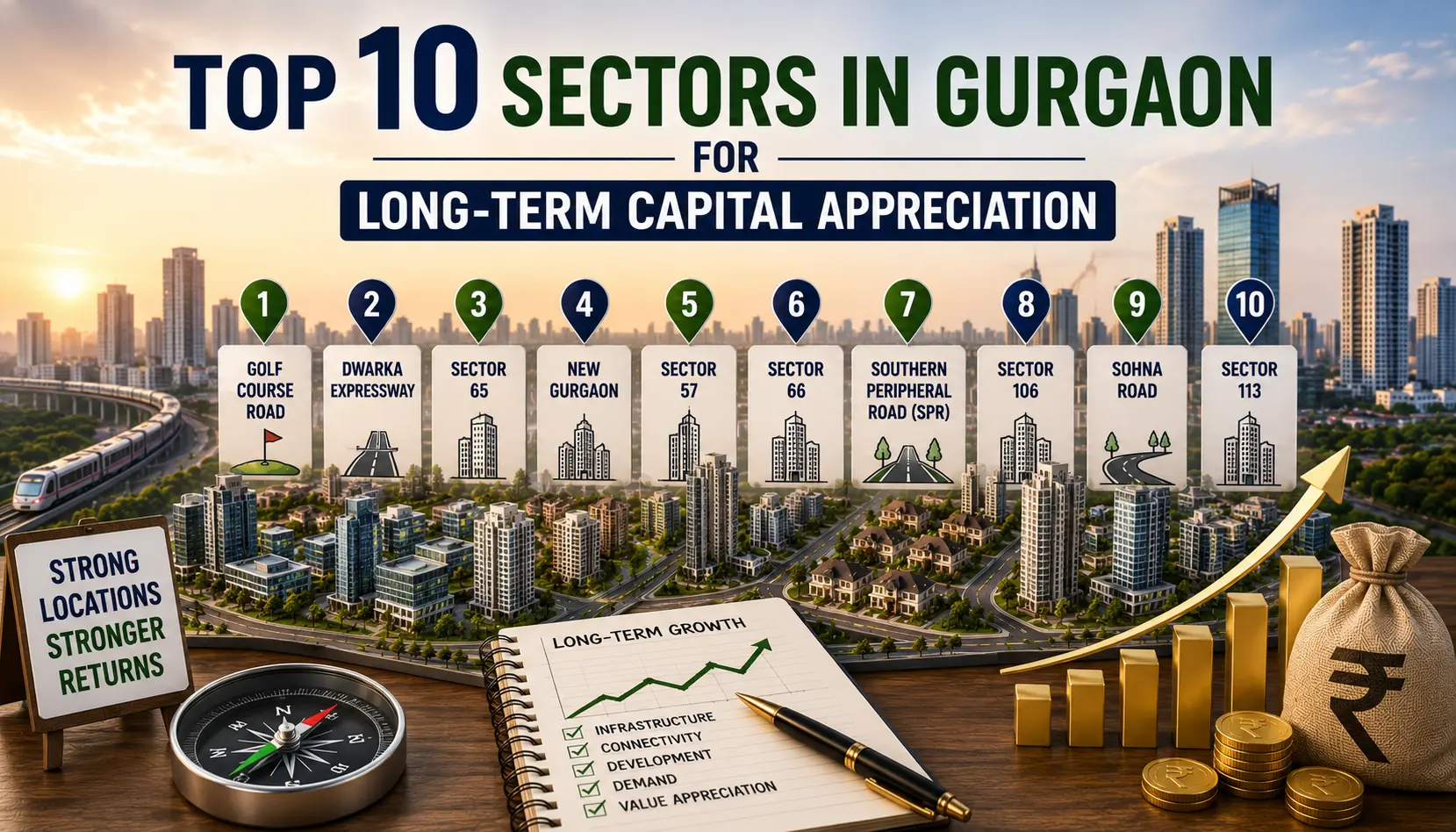
A data-backed ranking of the Top 10 Sectors in Gurgaon for long-term capital appreciation in 2026 — connectivity drivers, price trends, and which each sector suits.
Top 10 Sectors in Gurgaon for Long-Term Capital Appreciation
For long-term capital appreciation in 2026, the strongest Gurgaon sectors cluster around three corridors — Dwarka Expressway (Sectors 102–113), New Gurgaon (Sectors 82–93), and Golf Course Extension Road (Sectors 61–70) — with Southern Peripheral Road (SPR) and select pockets of Sohna Road close behind. There’s no single “best” sector; the right one depends on your time horizon, budget, and whether you’re optimizing for appreciation, rental income, or stability.
This article builds on our Complete Guide to Calculating ROI on Gurgaon Property Investment. Read that first if you haven’t, so you can apply the ROI formulas to whichever sector you shortlist from this list.
How We Ranked These Sectors
Capital appreciation in Gurgaon isn’t random — it follows a fairly consistent pattern tied to three drivers: infrastructure completion (expressways, metro extensions), employment proximity (corporate hubs, business districts), and supply-demand balance (limited new launches vs. growing end-user demand). Sectors entering the “infrastructure visible but not yet fully priced in” phase have historically delivered the strongest appreciation, while fully mature corridors tend to offer stability and liquidity over explosive growth.
With that framework, here are the ten sectors and corridors currently positioned for the strongest long-term capital appreciation.
1. Sector 113 — Dwarka Expressway / NH-48 Junction
Sector 113 sits at the point where the Dwarka Expressway meets NH-48, one of the most strategically positioned junctions in the entire corridor. As the expressway nears full completion and commercial activity accelerates around it, this location benefits from both connectivity and proximity to established business zones. Large-format residential projects from major developers have already established a strong presence here, which typically signals sustained long-term demand.
Best suited for: Investors with a 5–7-year horizon comfortable with a still-maturing corridor in exchange for higher upside.
2. Sectors 102–109 — Dwarka Expressway Core
This stretch links Delhi directly to Gurugram and offers strong connectivity to IGI Airport, Dwarka, and major business centres. As the superhighway approaches full completion and commercial development accelerates in the surrounding areas, property values here are positioned for substantial appreciation. Sector 103 specifically benefits from expressway access and proximity to both Delhi and the airport, while Sector 104 is increasingly viewed as a transformation play tied directly to the connectivity upgrade.
Best suited for: Investors prioritizing connectivity-driven appreciation over immediate rental yield.
3. Sectors 82–93 — New Gurgaon
New Gurgaon has developed into a well-planned urban district with strong road connectivity to Manesar, Delhi, and key industrial belts. Sectors 82 and 83 in particular, offer integrated townships with schools, parks, hospitals, and daily retail built into the community — a structural advantage older, more piecemeal sectors weren’t designed with. Combined with the upper Dwarka Expressway stretch, this zone tends to show the largest gap between current pricing and future potential, since infrastructure here is still maturing and hasn’t yet been fully priced in.
Best suited for: Long-term capital growth investors and families prioritizing integrated, self-contained communities.
4. Sector 65 — Golf Course Extension Road
Sector 65 sits in the middle of the Golf Course Extension Road belt — Gurgaon’s steadiest premium residential address. What distinguishes this pocket isn’t just housing quality, but the density of commercial and lifestyle activity around it. Appreciation here tends to be more moderate than emerging corridors, but it comes with materially lower execution risk and strong liquidity, since this is one of the most established premium markets in the city.
Best suited for: Investors who want luxury positioning with a “safer, steadier” appreciation profile rather than a high-risk, high-reward bet.
5. Sectors 61–70 — Golf Course Extension Road (Broader Belt)
Beyond Sector 65 itself, the broader GCX Road belt (Sectors 61–70) has cemented its position as Gurgaon’s premier luxury corridor. This area commands some of the highest rents in the city even where price appreciation has moderated, simply because tenant demand here rarely softens. Recent data shows this corridor posting some of the strongest 5-year appreciation figures in the city, alongside its already-strong rental fundamentals.
Best suited for: Investors who want both meaningful appreciation and dependable rental demand in the same package.
6. Sectors 84–85 — Southern Peripheral Road (SPR)
SPR connects Golf Course Extension Road to NH-48, making it a critical link in Gurgaon’s broader infrastructure network. Several luxury residential and commercial projects are currently under development here, and prices have already shown rapid movement — in some reports, doubling within just three years. The corridor still has runway left, but entry prices have already shifted meaningfully compared to a few years ago, meaning the easiest gains may be behind early entrants, while later entrants should expect a more moderate, multi-year payoff.
Best suited for: Mid-to-high-budget investors with a realistic 3–5-year horizon and patience for the corridor to mature further.
7. Sector 77 — Dwarka Expressway (Entry-Level Pocket)
Within the broader Dwarka Expressway corridor, Sector 77 stands out as a comparatively affordable entry point. Prices here have already doubled following the expressway’s opening, yet entry costs remain lower than those of the more premium Golf Course Extension corridor — positioning this pocket as a strong value play for mid-budget investors who missed the earliest entry window elsewhere on the expressway.
Best suited for: Mid-budget investors seeking expressway-driven appreciation without Golf Course Extension-level entry prices.
8. Sector 36A — Emerging Premium Pocket
Sector 36A has emerged as a notable premium pocket, distinguished by limited competing supply in its specific product category. Limited supply in a high-demand category typically supports stronger resale value over time, since scarcity protects pricing even during broader market softening.
Best suited for: Investors prioritizing a differentiated, lower-competition asset over a high-volume corridor.
9. Sector 70 — SPR / Golf Course Extension Overlap
Sitting at the overlap between SPR and the Golf Course Extension corridor, Sector 70 benefits from growing residential density alongside infrastructure spillover from both established neighbors. This positioning typically supports both near-term rental income and longer-term capital growth as the surrounding area continues to mature.
Best suited for: Investors who want a blended profile — some rental income now, appreciation later — rather than betting entirely on one or the other.
10. Sector 31 — Central Gurgaon (Stability Pick)
The one outlier on this list by design. Sector 31 represents central Gurgaon’s stability case rather than an aggressive appreciation play — central, established locations rarely deliver explosive price growth, but they consistently outperform on liquidity and capital preservation. Including a stability-oriented sector matters because pure appreciation-chasing without any liquid, lower-risk anchor in your portfolio is a common mistake among first-time Gurgaon investors.
Best suited for: Investors who want one holding in their portfolio that prioritizes easy resale and capital protection over maximum upside.
Quick Comparison Table
| Sector / Corridor | Appreciation Profile | Risk Level | Best Time Horizon |
|---|---|---|---|
| Sector 113 (Dwarka Expy / NH-48) | High | Medium-High | 5–7 years |
| Sectors 102–109 (Dwarka Expy Core) | High | Medium-High | 5–7 years |
| Sectors 82–93 (New Gurgaon) | High | Medium | 5–10 years |
| Sector 65 (GCX Road) | Moderate | Low-Medium | 3–7 years |
| Sectors 61–70 (GCX Road Belt) | Moderate-High | Low-Medium | 5–10 years |
| Sectors 84–85 (SPR) | High (already partly priced in) | Medium-High | 3–5 years |
| Sector 77 (Dwarka Expy, entry-level) | Moderate-High | Medium | 3–5 years |
| Sector 36A (emerging premium) | Moderate-High | Medium | 5–7 years |
| Sector 70 (SPR/GCX overlap) | Moderate | Medium | 3–7 years |
| Sector 31 (Central Gurgaon) | Low-Moderate | Low | 3–5 years (liquidity-focused) |
How to Use This List
This ranking is a starting point for research, not a buy signal. Before shortlisting any sector:
- Run the ROI formulas from our complete guide using current asking prices in your shortlisted sector, not city-wide averages.
- Check RERA registration for any specific project at hrera.org.in, and confirm the project name, developer name, and unit configuration match exactly before paying anything.
- Match the sector to your goal using our rental yield vs. capital appreciation framework — an appreciation-focused sector and an income-focused sector are not interchangeable.
- Factor in hidden costs from our companion guide — stamp duty, GST (if under construction), and maintenance vary meaningfully even between sectors in the same corridor.
FAQs
Which Gurgaon sector has shown the strongest appreciation recently?
Corridors along the Dwarka Expressway and New Gurgaon have generally shown the strongest recent appreciation, since infrastructure completion in these zones is still being priced in. Golf Course Extension Road has also posted strong multi-year appreciation while maintaining the city’s highest rental demand.
Is it too late to invest in SPR or Dwarka Expressway after the recent price run-up?
Not necessarily, but expectations should be reset. Early entrants in both corridors captured the steepest part of the appreciation curve; later entrants should plan for a longer, more moderate holding period rather than expecting a quick re-run of recent gains.
Should a first-time investor start with an emerging sector or an established one?
There’s no universally correct answer — it depends on risk tolerance and time horizon. Many experienced investors deliberately hold a mix: one stability-oriented holding (like central Gurgaon) alongside one or two higher-growth, higher-risk holdings in emerging corridors.
Next Article
- How to Calculate ROI on Property Investment
- Rental Yield vs Capital Appreciation: Which Matters More for Property Investors?
- Hidden Costs That Kill Your Property ROI
Disclaimer: This article is for educational purposes and reflects market commentary and trends as of mid-2026. Sector-level performance is influenced by project-specific and timing factors not captured here. Always verify project RERA registration and consult a licensed financial advisor or real estate professional before making investment decisions.